Product Description
A cylindrical autoclave is a type of pressure vessel used for sterilization. It's typically shaped like a long, cylindrical tube and uses high pressure steam to kill microorganisms such as bacteria, viruses, and fungi. Here are some key things to know about cylindrical autoclaves:
Design:
- Horizontal vs. Vertical: Cylindrical autoclaves come in both horizontal and vertical orientations. Horizontal models are more common and offer larger loading capacities, while vertical ones are better suited for limited space.
- Double/Triple Walled: Many cylindrical autoclaves have double or triple walls. The outer wall contains the pressure vessel, while the inner wall houses the chamber where materials are sterilized. The space between these walls often circulates steam or hot water for better temperature control and insulation.
- Door: The door is a critical component, designed to withstand high pressure and maintain a strong seal. It typically features safety interlocks to prevent opening while the chamber is pressurized.
Operation:
- Sterilization Cycle: The typical sterilization cycle involves removing air from the chamber, introducing saturated steam, reaching the desired temperature and pressure, holding it for a specific time, then depressurizing and exhausting the steam.
- Temperature and Pressure: Operating parameters like temperature and pressure vary depending on the materials being sterilized. Common settings for medical sterilizers are 121C (250F) at 15 psi for liquids and 134C (273F) at 30 psi for instruments.
- Applications: Cylindrical autoclaves are used in various industries, including healthcare, pharmaceutical, biotechnology, research, food processing, and waste management.
Advantages:
- Large Capacity: Cylindrical autoclaves can accommodate large volumes of materials compared to other types.
- Uniform Temperature Distribution: The cylindrical shape promotes even heat distribution within the chamber, ensuring effective sterilization.
- Durable and Efficient: Well-built autoclaves can last for many years and operate efficiently with minimal maintenance.
Additional Information:
- Cylindrical autoclaves come in various sizes and with different features, ranging from basic manual models to fully automated units with touch screen controls and data logging capabilities.
- Safety is paramount when operating an autoclave. Proper training and adherence to safety protocols are essential to avoid accidents and injuries.
Robust Construction & DurabilityBuilt from high-quality SS304/SS316 stainless steel, both the chamber and exterior are engineered for longevity and corrosion resistance. Mirror-polished inner surfaces facilitate easy cleaning and minimize contamination. The chamber thickness (4-8 mm) conforms to stringent pressure vessel standards, ensuring safety and performance in demanding environments.
Advanced Automation & User InterfaceThe control system incorporates PLC or microprocessor-based automation with an HMI, granting precise command and monitoring of all sterilization parameters. Operators can monitor real-time data via LED/LCD displays and process indicators, while programmable cycles increase efficiency and apply stringent control over temperature and timing.
Safety, Efficiency & ComplianceThis autoclave includes essential safety features such as pressure switches, temperature cutoffs, and safety interlocks. Automatic solenoid valves, reliable sealing gaskets, and advanced insulation optimize performance and user safety. All operations conform to IS:3829/ISO/CE international standards, matching global expectations for reliable sterilization.
FAQ's of Cylindrical Autoclave:
Q: How does the PLC/microprocessor-based automation system enhance operation of the autoclave?
A: The PLC or microprocessor-based control panel with HMI enables highly precise control and programmability of sterilization cycles. Users can easily set profiles for temperature, pressure, and duration, monitor the real-time status, and ensure consistent results through automated safety interlocks and digital recording of sterilization data.
Q: What are the key benefits of using stainless steel SS304/SS316 for the chamber and piping?
A: SS304 and SS316 stainless steel provide excellent corrosion resistance, high strength under pressure and temperature, and a smooth, hygienic finish. This durability and resistance to chemicals or frequent use make the autoclave suitable for critical applications across hospitals, pharmaceuticals, laboratories, and food industries.
Q: When should the optional multi-stage vacuum cycle be used?
A: The optional multi-stage vacuum system should be selected whenever air removal from the chamber is necessary to ensure deep penetration of steam into porous or packaged loads. This feature is particularly beneficial in pharmaceutical, laboratory, and research settings where complete sterilization is critical.
Q: Where can the cylindrical autoclave be installed for optimal usage?
A: This autoclave is designed for installation in hospitals, pharmaceutical manufacturing, research laboratories, and food processing units. It can be set up wherever reliable and efficient sterilization is needed, provided there is availability of 6-8 Kg/cm2 compressed air (for automatic operation), electricity, and an external steam source if needed.
Q: What safety mechanisms are integrated in this autoclave?
A: The autoclave incorporates pressure switches, temperature cutoffs, safety interlocks, automatic solenoid valves, and a pressure-proof radial locking hinged door. These features collectively prevent overpressure or overheating, and protect users during the sterilization process.
Q: How does the device ensure uniform temperature and reliable sterilization?
A: The autoclave utilizes heavy-duty immersion heaters and rotary/static adjustable spray modes to distribute steam uniformly. With up to 1C temperature uniformity across the chamber and programmable sterilization cycles, high-grade insulation ensures minimal heat loss, producing consistent and thorough sterilization.


 Send Inquiry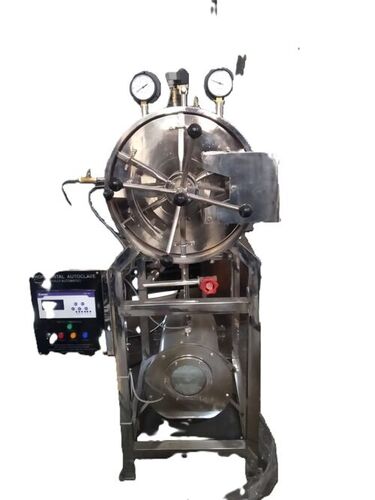


 Send Inquiry
 Send SMS
